Tuesday, October 25, 2016

Psalm 23 and the Lord's Prayer: An Exercise in Providence

Psalm 23 and Jesus’s prayer from Matthew 6 are two of the most well known passages of Scripture in the modern world. For centuries, believers have memorized and recited these passages because of the comfort and insight they offer. Several years ago, I was fortunate to be part of a class led by Dallas Willard. During that course, a student asked him what had been the most beneficial Spiritual practice of his life. He answered that at morning and at night, he recited and meditated on the Lord’s Prayer or Psalm 23.

For the next year, I took up that practice. Every morning before getting out of bed and every night before going to sleep, I would pray through and meditate on one of these two passages. They proved to be more fruitful for my faith and overall sense of peace than I would have estimated from the beginning. With careful attention and prayer seeking for insight, I discovered that when taken together, Psalm 23 is actually a perfect answer to the petitions of the Lord’s prayer.

What follows is an exposition of this insight. What you will notice below is that every statement or petition Jesus offers in this prayer is answered, and even surpassed, by the confident assertion David makes in Psalm 23.

Jesus’ Prayer: Our Father in heaven, hallowed be your name, your kingdom come, your will be done, on earth as it is in heaven.
Psalm 23: The Lord is my shepherd; I will not be in want.

Here Jesus opens his prayer with the affirmation that God is Holy and the assertion/request that God’s will be carried out in our lives just as it is in the spiritual realm. The psalmist answers saying that God is Shepherd. The metaphor implies that as a sheep looks to the shepherd for protection, support, leading, and sustenance, God is the one who provides all these things precisely because he is all the things that Jesus asserts.

Jesus’ Prayer: Give us today our daily bread.
Psalm 23: He makes me lie down in green pastures, he leads me beside quiet waters, he restores my soul.

This is the first direct request that Jesus makes in the prayer. The psalmist asserts that the answer, from his experience with the Lord, goes far beyond the simple request for daily bread. Continuing the metaphor of shepherd and sheep, David says that he lies down in green pastures. This is a clear reference to a sheep that has had its fill of good food, and feels safe and secure. No sheep lies down in a green pasture unless it has eaten all it wants and feels safe to lie down. The implication is clear. David, as the sheep, enjoys the protection and provision of a good shepherd. He also speaks of access to still waters, another reference to safety and having all his needs met by his shepherd. Finally, he goes beyond the physical needs to the deeper spiritual and personal needs “he restores my soul.” Jesus requests God’s provision. The psalmist asserts that in relationship with the Lord all these are met and them some!

Jesus’ Prayer: And forgive us our debts, as we also have forgiven our debtors.
Psalm 23: He guides me along the right paths (or in paths of righteousness) for his name’s sake.

Here Jesus asks for the forgiveness we all need in order to be right with God. He qualifies it by asking that we be forgiven as we in turn forgive others. The psalmist answers that God goes beyond this request. God not only forgives, but leads him to be righteous in all his ways. He adds that God does this, “for his name’s sake.” In other words, God guides and empowers us to forgive as he forgives. He leads us to act rightly and justly so that others will see his influence in our lives and be drawn to God as a result. The right paths the psalmist speaks of are paths that draw us closer to God and others in the context of right relationships. The foundation is being gracious – forgiving as we have been forgiven – but beyond that, living in the righteous example of God in all ways. For the psalmist, God answers the request by shaping and directing us in all our relationships in such a way that His name is blessed in our lives.

Jesus’ Prayer: And lead us not into temptation, but deliver us from the evil one.
Psalm 23: Even though I walk through the valley of the shadow of death, I will fear no evil, for you are with me; your rod and your staff, they comfort me. You prepare a table before me in the presence of my enemies. You anoint my head with oil; my cup overflows.

So far, the psalmist has declared that God’s response goes above and beyond Jesus’s request at every step. This answer reaches the pinnacle of that insight. Jesus asks that God not lead us into temptation, and delivers us from evil, Psalm 23 answers with a treatise on God’s power and provision in the face of danger and the enemy. Temptation is the borderland of Spiritual danger. The psalmist asserts that even in the darkest, or most frightening place, there is no need for fear if one walks with God. The shepherd’s rod and staff in the hand of God represent both discipline and protection. God by the side of the psalmist means that he is not alone to face any trial or temptation that threatens to harm him. The next image is the most powerful. “He prepares a table before me in the presence of my enemies.” It is as though the psalmist faces his enemies on the field of battle. God enters the scene, telling the enemy to stand back and watch, as God spreads out a banquet table in front of him. Then he calls David to sit and eat, while the enemy looks on. He anoints David’s head with oil, showing that he is God’s chosen one, protected and dearly loved. He is so greatly cared for that his cups overflows. All this is done with the enemy held in check and looking on! God’s provision is complete.

Jesus’ Prayer: For yours is the kingdom and the power and the glory forever and ever. Amen
Psalm 23: Surely your goodness and love will follow me all the days of my life, and I will dwell in the house of the Lord forever.

Jesus closes the prayer as he began, asserting that God is indeed Lord, and that power and glory belong to Him. The psalmist asserts that because this is true, he will benefit from the peace, goodness, and blessing that come from living under God’s rule.

Final Note:
When I first noticed this connection between these meaningful passages, I had the same thought that I am sure many of you reading this have: “Psalm 23 is certainly not intended to be the answer to Jesus’ prayer. David wrote the psalm out of his own experience, based on the times in which he was living, not as a prophetic word waiting for a prayer that would not be uttered for 1,000 years!” Certainly, there is a strong sense in which this is true. Psalm 23 stands on its own merit as a passage of assurance and peace completely independent of Jesus’ prayer in Matthew 6.

On the other hand, consider this. Scripture can have layers of meaning to different people at different times. This is evidence of the genius of the Spirit of God as he shapes and empowers us through His word. I believe that God was involved in the process that inspired David with insights that led to the writing of Psalm 23. It is God himself, in the person of Jesus, who spoke this prayer as an example of prayer for his disciples. The two passages work together so well. They each interpret and inform greater insight into the other. With God involved in both, this should come as no surprise.

David is the great King of Israel. God promises that his line will never end and that one will come in his line who will stand as the Christ, the Messiah, the one whose reign will never end. Jesus is that Chosen One. He speaks this prayer as example to all believers so we will know better how to structure our own prayers. In his providence, God inspires the answer to this prayer some 1,000 years before in the words of David. Only God could inspire the answer to his own prayer 1,000 years before it was spoken!

This is not out of character for God. It is right in line with what God has done all along. Consider another example, Paul writes in Romans 5: “While we were still sinners, Christ died for us.” In essence, before we ever knew we needed a way back to God, he had already made the way through the blood of Jesus. In a similar way, I am suggesting that Psalm 23 can be read as an insightful response to Jesus’ prayer, given before the prayer was ever spoken.  I am not saying that Psalm 23 must be only seen in the context of the prayer of Jesus. I am saying that putting these two together offers us great insight and food for our souls. The fact that God utters the prayer, in the form of Jesus the Messiah, and David, the first king in the line of Messiah, penned words in advance that would fill out the meaning of that prayer, seem to be the kind of providence and wisdom that bespeaks the power and grace of God.


If the insight I suggest does not make sense to you, or seems inappropriate, then let it go. If it feels more like a blessing, then be blessed. Either way, at the very least, consider making these two passages a more frequent part of your life of connection to God through prayer and contemplation of his word.

Saturday, April 2, 2016

Take a Good Look in the Mirror

Everyone loves a good story. We all have our childhood favorites. I remember being enraptured by the story of Jack and the Bean Stalk. I knew it wasn’t real, but it seemed like such a great adventure. As I grew older, I could look back on those stories and see how they shaped the way I saw the world. I first learned to be brave thinking about Dorothy taking one step at a time down the yellow brick road. I would laugh and think about the foolishness of building with straw and the wisdom of building with bricks as I recounted the story of the three little pigs and the wolf huffing and puffing to blow their house down. But, truly the stories that impacted me the most were stories from Scripture. I remember being fascinated by the story of the plagues in Egypt, or Gideon with his fleece, wet and then dry, and his boldness in testing God. Peter walking on the water and Moses standing before the burning bush both made me think about how incredible it must be to stand in a place where you cannot help but fully trust in God.
As I have grown and met my own trials and bumps on the road of life, these stories have been the ones that sustain me. Dealing with loss in my life or feeling inadequate to the task of ministry, I have looked to Moses at the burning bush or Peter starting to sink into the waves and found that I relate to them in profound ways. Like Moses, at times I have looked to the Lord and said, “Surely you can’t expect me to do this?!? There are others who are much more prepared or equipped for this task.” At other times I have felt like Peter and desperately looked to God saying, “I thought I could do this, now I am in the middle of it and it’s just not going how I planned. Is this your will for me? Please don’t let me drown! I know my faith is weak…Help!!!”

Looking back on how these stories have lifted, shaped, and sustained me, I am reminded of a simple but helpful metaphor offered in James 1:22-25. The author writes:

“Do not merely listen to the word, and so deceive yourselves. Do what it says. Anyone who listens to the word but does not do what it says is like someone who looks at his face in a mirror and, after looking at himself, goes away and immediately forgets what he looks like. But whoever looks intently into the perfect law that gives freedom and continues in it – not forgetting what they have heard but doing it – they will be blessed in what they do.”

Now that is sound advice. 

So often we take these stories from Scripture and set them up as only the stuff for Sunday school. We relegate them to the status of fairy tales and children’s stories. When we do this we miss the real power of the Word of God. It is with good reason that James calls it “the perfect law that gives freedom.” These stories are meant for you and me. They are real stories of real people who faced real issues in life. They are delivered to us to offer hope and guidance. They are meant to enable us to see what it looks like to follow God in every moment of our lives. If they are a mirror, they reflect what it looks like to follow God in our unique stories just as these biblical heroes did in their own life stories. Perhaps we should all pick up the Word this week, go back to some of those familiar stories, and take a good look in the mirror.

Wednesday, December 2, 2015

The Rogue Waves of Grief


This has been of season of many losses for people around me.  Several friends have lost loved ones in the past few weeks.  As I reflect on this I am reminded of a metaphor I have shared many times.  If you are dealing with loss and grief, I pray that this will bring you some clarity and peace.

I don’t think we are ever truly prepared for the death of a loved one.  We may know that it is coming and we may think it is time and we are prepared, but that moment of inescapable loss and the finality of losing always strikes us with surprise.  If it was not expected, the shock is even greater. 

It is like standing at the beach with your back to the water. Suddenly a rogue wave rises up behind you and crashes down over your head. You are tossed, taken by surprise, and disoriented. For a moment it feels like your feet are up and your head is down, but you are not quite sure which way is which. You cough and struggle for breath and finally get your feet on the ground to stand up and gasp for air.

Standing you turn to face the waves so as not to be surprised again. Then you realize that even though you may see them coming, those waves are not going to stop any time soon.  Still it is comforting to know that the biggest one already hit you and you survived. You go through the days and weeks ahead and little things trigger memories and unleash more waves of grief or sadness, but they seem to be getting, at least somewhat, more manageable. 

In the months ahead, you begin to realize that these waves come because of the gift of life and love that you have shared with the ones who are now gone. In time these waves become more like a welcome friend than a cold intruder.  They remind you of how much you are loved and how blessed you were to have this person in your life. Now these waves will remind you to love and share in return with others, making the memories of your loved one a legacy of giving as they gave to you.

Loss is never easy. It takes our breath away, but it also leads us to remember that life is worth living well. It jolts us back to what is true and most important. It calls us to never forget that each day is a gift to be lived and filled with memories that are blessed by the legacy of those  who have gone before us and passed on to those we know and love today.


In time we learn to embrace the waves and be thankful to God for the lives and memories that make the waves possible in the first place.

Wednesday, September 30, 2015

SJ18 - Athens

 Athens offers so much to see that it is impossible to do it justice in just one blog post. I will hit the highlights here VERY briefly and then post a larger album of photos on FB.
  The Acropolis
We spent a good bit of time walking around the Acropolis.  This is more impressive in person than i had imagined. It is absolutely beautiful. Unlike the Palace of Knossos, The acropolis remains pretty much unrestored.  As they make repairs or restorations, they are done is such a way the the original ruins are preserved. This leaves the ancient feel of the place intact. The sculptures seen here acting as pillars, are actualy copies. the originals are in the new Acropolis Museum.


From atop the Acroplis, There is a 360 degree view of Athens.  What a beautiful place!
The Temple of Zeus

View of Mars Hill

Ancient Theater
 Acropolis Museum
The new museum of the Acropolis is spectacular.
This photo is a view of the museum from the top of the Acropolis. As you can see, the top floor is not set square with he rest of the building. It is set so that it matches perfectly with the orientation of  the Acropolis.  They have set up a reconstruction of the Acropolis on that floor, with hundreds of the sculptures from the original so they are preserved. This give a very clear impression of the beauty and magnitude of the original building was in its prime. Below are some photos of a few of those pieces. More will beposted in my Athens album on FB.


On a lighter note, one of the more unique displays in the museum was a detailed Lego sculpture of the entire Acropolis hill and all of its buildings.  It included people from every period of Athens history, from gladiators to tourists coming off of buses.  Detailed ad hilarious!

 Mars Hill
We also visited Mars Hill.  It was a stirring experience to stand in ths place , with the Acropolis in view, hear Paul's words echo in my mind:

“People of Athens! I see that in every way you are very religious.  For as I walked around and looked carefully at your objects of worship, I even found an altar with this inscription: to an unknown god. So you are ignorant of the very thing you worship—and this is what I am going to proclaim to you. The God who made the world and everything in it is the Lord of heaven and earth and does not live in temples built by human hands. . .
                                                   Acts 17: 22 and following

This is the view of the Acropolis from Mars Hill.  I imagined Paul
pointing to this when he sadi that God does not live in a temple made n=by human hands. Standing there was a powerful time of prayer and reflection for me.


Church in the Glyfada neighborhood of Athens
On Sunday night before flying out on Monday for home, Tami and I attended church with Dino Russos.  THey have three services every Sunday, one in Greek, one in Russian and one in English.  I was blessed to preach there during there English speaking service..  In attendance were about 30 Students from Harding who are in Athens for the semester. what a great church!  Following the service there were two baptisms as a result of Bible studies that are ongoing.  This church is doing great work for the Gospel here in aAthens!


Reflecting on the journey
As we close out our time here in Athens, I can't help but reflect on this entire journey.  Tami and I are so blessed to have been able to make this trip. We have the Conejo Church to thank for that.  This has truly been a time of refreshing and renewal for both of us. To get away together for three weeks is blessing in itself. To get away in such amazing places is almost beyond words!  It has been a whirlwind - Istambul - Albania - Greece - the trip of a lifetime!


SJ17 - Ancient Corinth with Alex and Eleni

Today we disembarked from our cruise ship for the last time.  The past four days have been an amazing journey with a hectic schedule and far too much really good food!  It was a wonderful experience. It has been a rich blessing to share this with Tom, Tami's Dad.  

After leaving the ship we were picked up by Alex and Eleni Melirrytos.  Tami and Tom both new Alex and Eleni, and I had heard my good friends Andy Wall and Mark Manassee speak highly of them, but I had never met them.  It didn't take long for me to see why people I admire , admire Alex and Eleni.  From the port, they took us straight to ancient Corinth.  Alex is a retired ship's captain and now preaches for The Omonia Church of Christ in Athens.  He is very knowledgeable and enthusiastic!  It was a real joy to go through ancient Corinth with these two.


While I am thinking about people who are a blessing...

I need to take a bit of an aside here and give credit where credit is due.  We not only met Alex and Eleni, but we also had lunch with Dino Russos, minister for the Glyfada Church of Christ.  During our time with these tireless workers for the Gospel, two names kept popping up in the conversation - Phil and Lois Wall.  The Walls were only in Greece for about 7 years ( and that over 30 years ago)  but their impact was tremendous.  Their influence is still felt by current church leaders all around Athens. Dino, Alex and Eleni each spoke very highly of their humility, grace-filled spirits, and love.  I felt so honored to hear these unsolicited stories about how God had moved through the Wall family and how their ministry so long ago is still bearing fruit.  Eleni shared a story with us that I think helps explain the lasting impact of the Walls.  While we were talking about the abundance of olive trees in Greece, she shared that her mother once told her to look to the olive branch as an example.  The branch that is full of fruit bends down low, while the branch with no fruit stands tall and sticks out.  She said, so it is with humble people.  God blesses the humble with much fruit, but the proud who fight to stand tall on their own rarely bear lasting fruit. I have paraphrased her words here, but they are a fitting tribute to Phil and Lois.  So before I go on, I think it fitting to say "Thank you!" to Phil and Lois Wall.  I have always sensed a humble spirit of grace and love around you.  It was wonderful to see it confirmed by those in Greece who know the Lord because of you.  They are carrying on the ministry of the Gospel because of your faithful example and service. You are truly a blessing to more people than you know or can count!

Now, back to today...

The Corinth Canal
On the way to ancient Corinth, we stopped to see an engineering wonder.   The Corinth Canal connects the Gulf of Corinth with the Saronic Gulf in the Aegean Sea. It cuts through the narrow Isthmus of Corinth and separates the Peloponnesian peninsula from the Greek mainland.  As a former ship's Captain, Alex is very animated about the canal and it submersible bridge at the Gulf of Corinth end.  His enthusiasm is understandable, because this canal is impressive. It is only  about 4 miles long, but it saves the ships which pass through it about a 200 mile trip around the isthmus. The narrow channel is about  only 70 feet wide at its base, but the cliffs flanking either side of the canal reach a maximum height of over 200 feet.  Impressive!
Ancient Corinth
I absolutely loved walking through Ancient Corinth with Alex ad Eleni!  Alex's knowledge and enthusiasm for the Gospel and his native lad are evident.  the photos belwo tel the story of what we saw here.

This is an ancient natural spring outside of Ancient Corinth. This specific spring is said to have been in use during the time of Paul.

This ancient symbol his called the "Chi-Rho." It has the Greek letters chi and rho put together as an icon, standing for Christ as savior. this particular symbol also has the letters Alpha and Omega - referring to Jesus as the first and te last. this was on the arch of the ancient fountain in te photo above.  we saw these symbols in several ancient places throughout Greece.

The museum at Ancient Corinth is filled with so many well preserved scuplutres and artifacts form the first century.  I will post a few here, but the majority will go into an album on Facebook.
Julius Caesar
Typical Roman Soldier Uniform
Nero - Alex said you could tell he wasn't very smart by just looking at him! HAHA!


This inscription from 1 Corinthians is e in the place where Paul likely stood before the seat of judgment in Acts 18.
The main road leading form te ancient port in to Corinth
Tami and Elani standing in front of the Bema seat in Corinth - the place of judgment.


Tuesday, September 29, 2015

SJ16 - Crete and Santorini

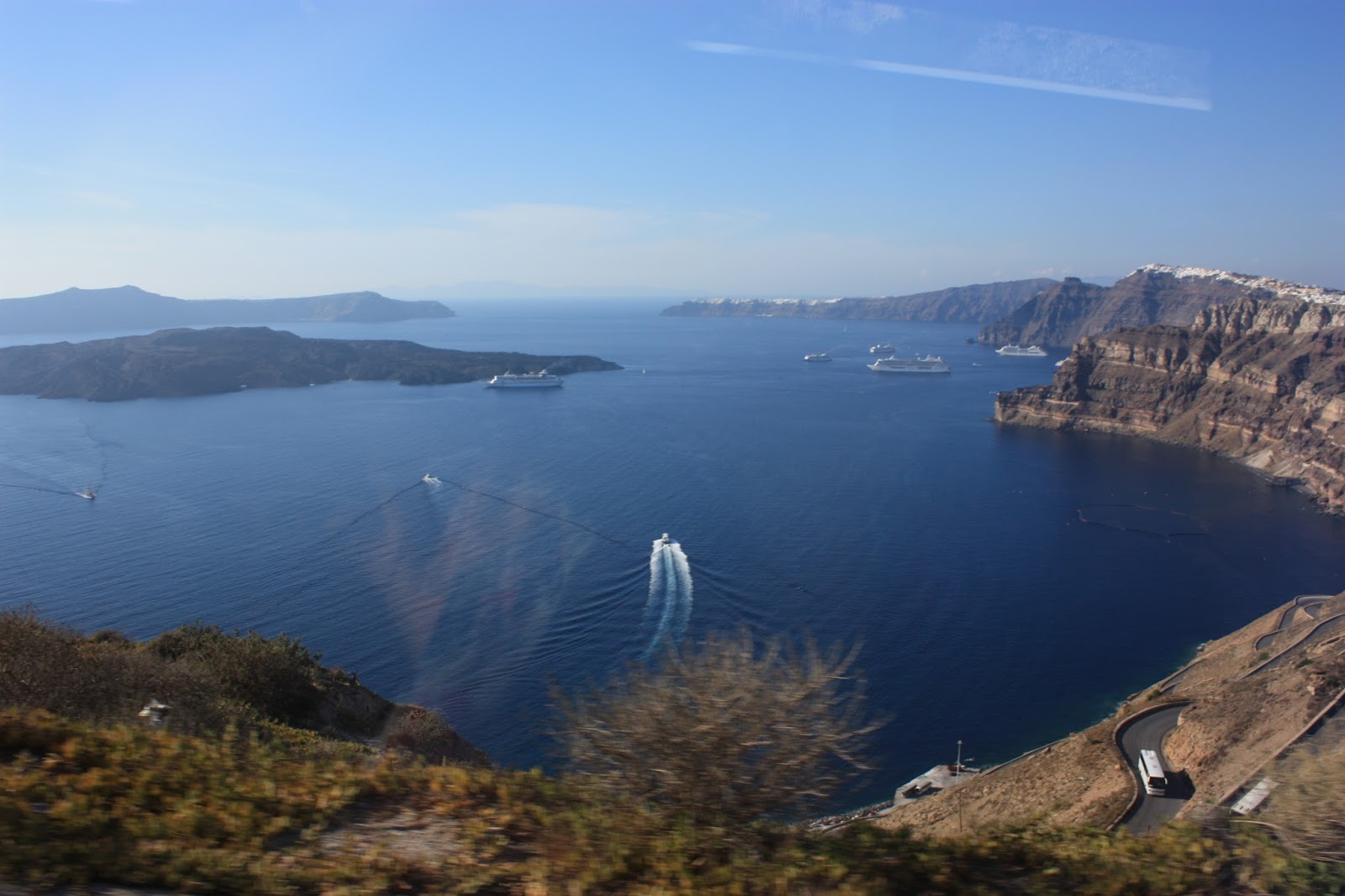
Today was another fast moving day. We made a whirlwind trip to the islands of both Crete and Santorini.  This cruise has been like a sampler platter of the Greek Islands. We have enjoyed every minute but not had as much time as we would like at any one place.  If that sounds negative, I don't mean it that way.  It has been wonderful!  Today was no exception.  Crete is such an immense island that we probably couldn't really see it all in a full week.  We spent our time at the Minoan Palace of Knossos, a wonder of the ancient world that is still being discovered. The afternoon and evening were spent on Santorini - easily the most beautiful place we experienced.

Palace of Knossos
The Palace of Knossos - pronounced kuh-noh SOS - is a massive, multi-leveled structure that was the cultural center of Minoan life. It is mentioned in Homer's Odyssey. The earliest parts of the palace were built sometime around 1900 BC. The site was discovered in 1878. Excavations began in AD 1900 under the supervision of English archaeologist Sir Arthur Evans and his team, and they continued for 35 years.  Evans made thousands of amazing discovries here and supervised the reconstruction of whole sections of the palace for the benifit of visitors.  According to our gide, not everyone in modern archeology is happy with Evans and his methods.  His desire was that people would be able to see this palace in its glory through reconstrction. Many would like him to have not tried to reconstruct, fearing that accuracty was lost in the process.

I am not an archaeology expert in any sense, but I am sympathetic with those who are disappointed by the reconstructions on the site.  They are spectacular, but I think I would prefer seeing the actual, original ruins with artist renderings or models set up in the same vicinity.  None the less, to simply say this site is impressive would be an understatement.

Our guide describing one of the reconstructed frescoes
The palace had at least 6 different levels with a massive staircase weaving up and down like a labyrinth. It also had both hot and cold running water and toilets in the royal quarters, equipped with continually running water. This is still an active archaeological site today. There has  been evidence of civilization here dating back as far as  the 8th century BC.


Part of the water system running throughout the palace
reconstructed part of the ancient staircase


Santorini
The island of Santorini is clearly volcanic.  Its quaint, beautiful houses and churches are set high above the cliffs of the ancient caldera.  If you have ever seen pictures of stunning white buildings with blue doors, or white churches with blue domes, it was very likely Santorini.


Looking up at the cities atop caldera from sea level


The view from atop the caldera back toward our ship
 The City of Oia (EE-ah), which we visited, has a population of about 1,000 and 70 of these beautiful churches/chapels. From what we saw it probably also has about half as many dogs and cats as people.

 This was our last full day of the cruise. Tomorrow we head back to Athens where we will meet Alex and Eleni Melirrytou. They will lead us on a tour of ancient Corinth!  These are good days!


SJ15 - The Island of Rhodes

-->
We absolutely loved our day at Rhodes, even though the rains caught up with us again in the afternoon.

The medieval influence of the Crusaders is more evident on Rhodes than anywhere we have seen so far. In 1309  the Order of the Knights of Saint John of Jerusalem took control of the island. They maintained control, and the island greatly prospered under their leadership, until 1522 when the Turks conquered the island and the Ottoman Empire held sway. 

The fortified walls and architecture of the Knights era are still largely intact and set the atmosphere of this beautiful island.  We walked for hours around the city, admiring the ancient marble paths and the solid stone walls.  The shields and emblems that were built into the walls at regular intervals all around the city fascinated me.  The craftsmanship and sheer imposing nature of these protective walls is incredibly impressive.


Later that afternoon, Tami and I decided to take the twenty minute walk from our ship to a beautiful beach. We couldn't hardly wait to put our feet in the sea.  On the way, without much notice, the clouds rolled in and it started absolutely pouring
rain!  We got thoroughly and completely soaked, despite the fancy
 blue plastic ponchos we had bought the day before.  We stopped under the protection of a canopy at a roadside cafe until the worst of the rain passed by.  Then, undaunted we continued on to the beach. Once there, we found that it wasn't sandy at all, but covered with little rocks. They were all pretty smooth and easy to walk on. After I went into the surf, just to say I had put my toes in the Aegean, we noticed that a high percentage of the gravel below us looked like marble.  There is so much natural marble on the Greek Isles that even the curbs in Athens are made of marble. I guess you make use of what you have easiest on hand! That's just one more example of the amazing surprises we have so often found along every leg of this trip. Tomorrow it is on to Crete!